A classic barn find, 1955 Bristol 405 Drophead
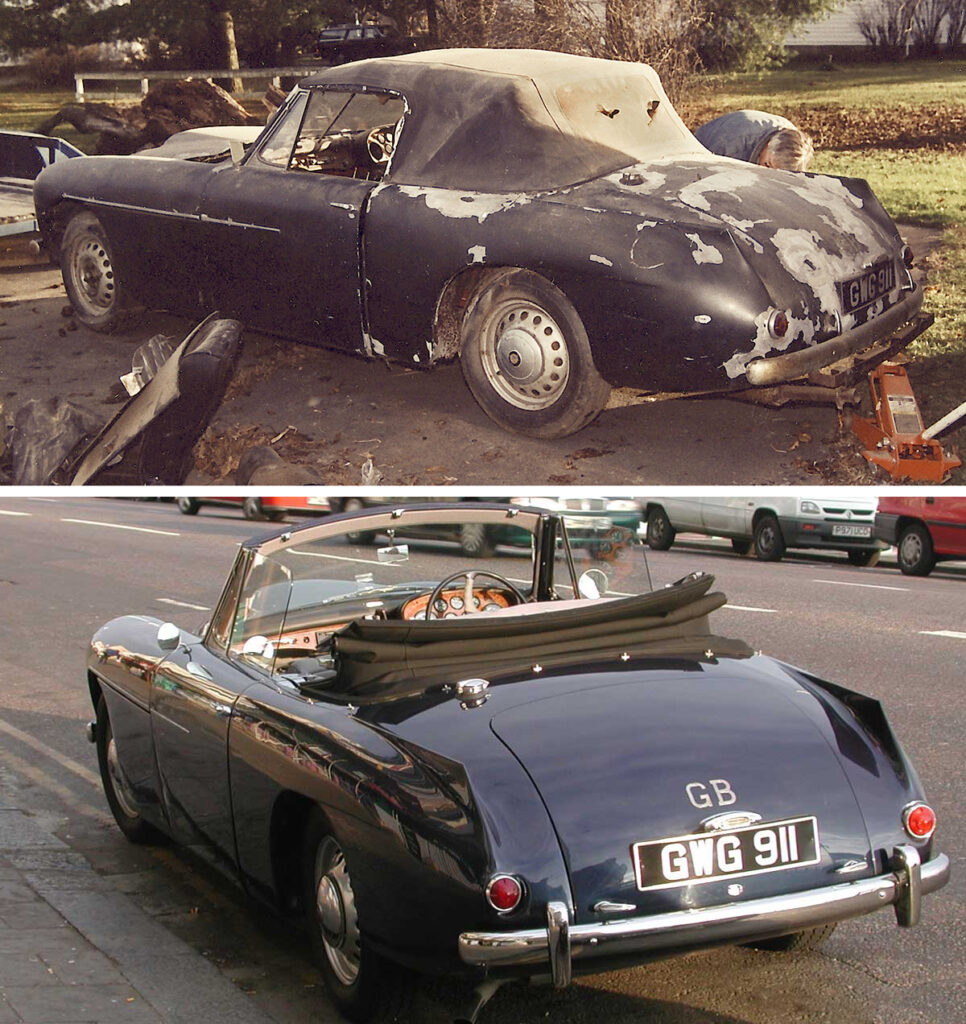
This is the same car after a $150,000 restoration.
It was imported into New Zealand under the old pre-2002 first inspection (also called VIN inspection), but was not completed until after the new rules came into effect. Rather than face being required to undo the restoration, blast off all the chassis protection and have holes drilled to inspect inside cavities, the car was exported to the UK.
As only one of 45 Bristol 405 dropheads ever made, and the only one in New Zealand at the time, this overseas sale was a cultural loss for the nation.
This is another victim of the 2002 rule change,
1969 Alfa Romeo 1750 Veloce Spider
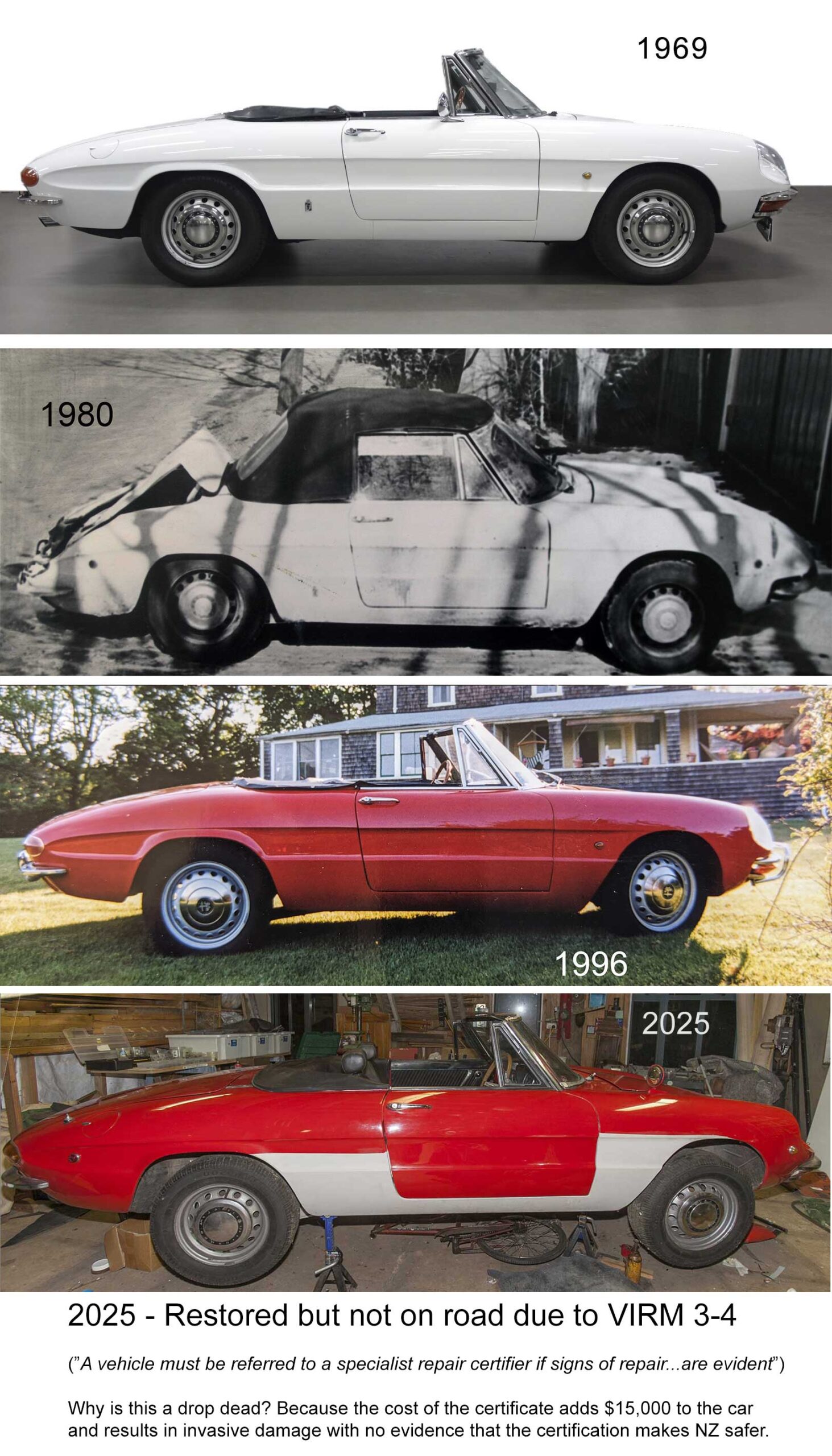
New in 1969, it was crashed in 1980. The president of the overseas Alfa club bought it and did a complete restoration. After his death (old age), it went through two more owners until the current owner bought it and did a cosmetic restoration (new paint and mechanicals). In 1997, the owner moved to New Zealand and brought his collection with him.
Because at the time, New Zealand had some of the best restorers in the world, he elected to have Alan Bowden replica floor and sill pressings to bring the car back to its original look. Unfortunately, this was still underway when the 2002 rules came into effect, with an estimated $10,000 to obtain the LT308 Repair Record of Certification. Having just encountered this with another car in his collection (a Bristol 411), he towed the car home where has sat every since.
Unless VIRM 3-4 is changed, it too will be shipped out.
FAQs
Why is there a problem?: VIRM 3-4 Repaired Damage is a short cut appropriate for late model used car imports but bad for the collectible vehicle economy. It adds cost, intentionally damages vehicles, adds no value, discourages collectors and eventually results in restoration shops and anciliary services closing down. It does not promote safer roads because collectibles are statistically more safe than transport vehicles. While collectibles may lack crash mitigation design and have fewer driver assistance features, the reason they are safe has to do with the maturity of the drivers, when they are driven, where they are driven and how they are driven.
Why 25 years? Car makers support their product for ten years. From 10-20 years they become old cars with a downward depreciation curve. At about 20 years the curve flattens as many of these old cars are culled, scrapped or stored in barns, sheds and garages. The survivors are called classics. At about 25 years, the value of survivors begins to rise. The best ones begin to become collectible, and by 30 years most survivors have become collectible. Most, not all, hence only protect the collectibles. By 40 years, the value has risen to the point that barn finds become financially viable candidates for restoration. The cull tends to end with very few survivors being scrapped
Why a High Court Declaration? The most efficient way to resolve this is for the Minister to use his delegated power to amend the VIRM. However, getting his attention, especially in an election year, is challenging. A High Court Declaration is a direct path to addressing the matter. But it also calls the Minister’s attention to the issue.
What is the business model difference between transportables and collectibles? NZ car dealers buy late model Japanese Domestic Models (JDM) because the Japanese Car Manufacturers use their political clout to sell new cars. Because they are right-hand drive, the used car market is profitable for importers. As any time profit is the motivator, a few bad actors cheat. The role of government is to protect the customer who is sold a used JDM car in New Zealand. In contrast, almost all collectibles purchased overseas are sought out and shipped to New Zealand by the collector. They do not need government protection because they know exactly what they are buying, and they are not buying it to resell.
Why does motivation matter? A collector does not have the motivation to cheat themselves. They do not want their car to be unsafe because they will be driving it. Governments regulate pecuniary interest because greed makes people do dishonest things. Collectors are not driven by greed – the money they spend on their collectible is entertainment, not an investment.
Explain more: With the exception of the very top of the market, almost all collectibles are revenue negative, meaning when one adds the unpaid time invested along with the cash paid out, the collector rarely makes a profit. For example, a collector buys a 1969 car in 1980 for $4,000 and sells it in 2024 for $25,000. They think they did well, until they plug the numbers into https://www.rbnz.govt.nz/monetary-policy/about-monetary-policy/inflation-calculator to see at a 4.2% compound interest rate that $4,000 would return $25,000 without the nights and weekends spent in the shed, the money for parts, rust repair and new paint. So why do they do it? Because they enjoy spending nights and weekends in the shed. They enjoy the great feeling when finally it is driven out of the shed and they take it to a club weekend to show it off and see other members’ cars. It’s the same as going to Las Vegas… rationally, why would someone fly across the ocean to go to a place where one walks in with $10,000 and walks out with $10? Because for them, it is fun.
What’s the problem with secondary inspections of collectibles? By definition, almost all collectibles are of a different era. They are the survivors of the cull of transportables where 90% are taken off the road, some having crashed, others broken for parts or not worth repairing. The remaining 10% are taken in for inspection where a reading of the qualification standards for the inspector will show there is no training or experience required for a collectible. The collectible was designed and manufactured in a different era. Most will not have onboard diagnostic computers to tell the inspector what the sensors are saying because the cars are analogue, not digital. Many will be much stronger than contemporary transportables because they were designed in a pre-CAD era.
The first problem with 3rd party inspections is the cost. A first-entry inspection and certification can cost $10,000 or more and not improve the collectible in any way. The second problem is the inspector not knowing what they are looking at and failing the vehicle when it is roadworthy and safe, but was manufactured to standards unfamiliar to the inspector. The third problem is liability. The inspector is held liable for their work. The regime is so strict, the inspector makes unreasonable demands not for public safety, but to protect their exposure.